
Rental operators face a persistent profitability drain: vehicle damage disputes that end with the fleet absorbing costs rather than rebilling legitimate charges. According to analysis of 1,710 global claims in 2025, 58% of structural damage claims were not actually caused by the renter—yet documentation gaps allow customers to successfully contest charges. The core issue isn’t the damage itself, but the absence of defendable evidence capturing precise condition at check-in and check-out. Four specific data types eliminate this ambiguity, transforming vehicle inspections from liability exposure into revenue protection mechanisms.
Fleet profitability hinges on accurate damage attribution, yet most operators lack the forensic documentation required to win disputes. The shift from manual photo capture to structured digital inspections addresses this gap through precise metadata capture rather than simply digitising existing workflows.
The rental industry’s dispute resolution landscape has fundamentally changed. Where verbal walkarounds once sufficed, customers now demand verifiable proof—and arbitration bodies increasingly side with renters when fleet documentation lacks timestamp precision or location verification.
Before exploring each data type in depth, here’s the core framework that transforms vehicle inspections from liability exposure into revenue protection:
Your 30-second dispute prevention blueprint:
- Photo timestamps with server-synced metadata prove damage timing, eliminating ‘after return’ claims
- GPS coordinates validate inspection location compliance and contractual check-in requirements
- Severity scales (1-5 rating) replace subjective staff descriptions with defendable assessments
- Digital signatures capture real-time customer acknowledgment, preventing later non-disclosure claims
This guide examines each of the four critical data points through operational implementation and dispute prevention outcomes:
- Why rental disputes drain profits faster than vehicle depreciation
- Photo timestamps with metadata: building irrefutable damage timelines
- GPS-verified inspections: proving who, where, and when
- Standardized condition scales: replacing guesswork with consistency
- Real-time digital acknowledgment: closing the liability loop
Why rental disputes drain profits faster than vehicle depreciation
Vehicle depreciation represents a known, budgetable expense—fleet managers account for it in pricing models and disposal schedules. Damage disputes, conversely, create unpredictable revenue leakage that compounds monthly. When a customer successfully contests a £400 scratch repair charge due to insufficient check-in documentation, the fleet doesn’t just absorb the repair cost—it loses the rebilling revenue, pays staff time for dispute resolution, and often issues goodwill refunds to preserve online review ratings.
Industry observers note documentation quality remains the primary dispute trigger. Manual photo inspections lack the evidentiary weight required for modern arbitration, where customers routinely demand proof that damage existed before their rental period and occurred at the documented location. The operational bottleneck isn’t damage occurrence—it’s the inability to defend legitimate charges with timestamped, location-verified, consistently-assessed evidence.
Data comparisons collected and updated in January 2026. +33% rebilling improvement based on Hitech Software customer implementation results (2025-2026).
| Criteria | Manual Photo Inspection | Digital Inspection (4 Data Points) |
|---|---|---|
| Timestamp Precision | Camera clock (customer-adjustable) | Server-synced, unalterable metadata |
| Location Verification | None—photo origin unverifiable | GPS coordinates prove check-in location |
| Assessment Consistency | Subjective (‘minor scratch’, ‘small dent’) | Standardized scale (1-5 severity rating) |
| Customer Acknowledgment | Paper signature (separate from photos) | Linked digital signature with photo set |
| Successfully Re-billed Fees | Baseline | +33% increase |
Fleet operators implementing comprehensive digital documentation report measurable financial recovery. The shift from baseline to enhanced rebilling isn’t incremental—it represents capturing revenue previously written off as unwinnable disputes. When cloud computing for business scaling enables centralised access to inspection data across rental locations, multi-site fleets achieve consistency that manual processes cannot replicate. Staff at different branches apply identical assessment criteria, eliminating the documentation variability that customers exploit during disputes.
The 2026 industry analysis confirms operational urgency: rental operators face sustained pressure on fleet planning efficiency and damage detection accuracy. AI-driven predictive solutions are emerging, yet the foundational requirement remains unchanged—capturing the four critical data types that establish irrefutable damage timelines and accountability transfer points.
Photo timestamps with metadata: building irrefutable damage timelines
A regional fleet operator recently lost a £380 repair dispute because their manually-captured damage photo lacked verifiable timestamp metadata. The customer claimed the photograph was taken three days after vehicle return, potentially showing damage from subsequent rentals. Without server-synchronised timing data, the fleet couldn’t prove the photo was captured during the original check-out inspection. The arbitration panel sided with the renter, citing insufficient evidence of damage timing.
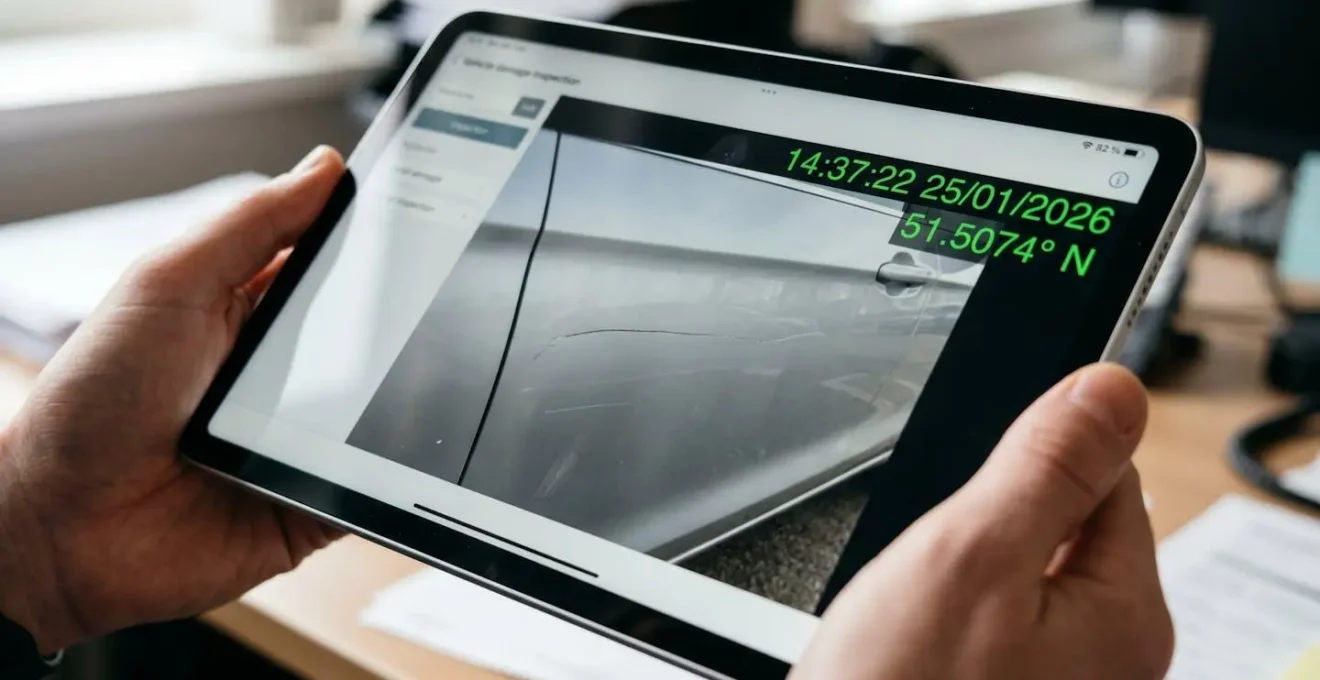
This scenario illustrates why timestamp precision determines dispute outcomes. Digital inspection platforms like Hitech Software‘s Myrentpad capture server-synced metadata at the moment of photo capture, embedding unalterable EXIF data that records exact date, time, and device location. Unlike camera-based timestamps that users can manually adjust, server synchronisation creates forensic-grade evidence—the photo’s creation moment is validated against an external time authority rather than relying on device settings.
The evidentiary weight difference is substantial. When customers claim “that damage wasn’t there when I picked up the vehicle,” fleets with timestamped documentation can prove the exact minute the damage photo was captured, cross-referenced against the rental contract timeline. Arbitration bodies increasingly recognise this metadata as credible evidence, particularly when combined with the additional verification layers discussed in subsequent sections.
Operational implementation requires tablet-based or smartphone-based inspection applications that automatically sync photo capture time with backend servers. Staff don’t manually enter timestamps—the system generates them cryptographically, preventing post-hoc alteration. This automation delivers dual benefits: inspection speed increases (check-in and check-out processes become twice as fast compared to manual documentation) while evidence quality simultaneously improves.
Fleet managers should verify their chosen inspection solution generates immutable timestamp metadata rather than simply displaying device clock time. The distinction determines whether photos withstand legal scrutiny or create the same temporal ambiguity that manual inspections produce.
GPS-verified inspections: proving who, where, and when
Most rental agreements specify that vehicle inspections must occur at designated company premises—typically the rental branch car park or designated return bay. Yet without location verification, customers can argue that damage photos were captured elsewhere or at a different time, undermining the inspection’s contractual validity. GPS metadata addresses this vulnerability by creating geographic proof of inspection compliance.
Consider the legal implication: a peer-to-peer car sharing platform faced an insurance claim rejection because their damage documentation lacked GPS coordinates. The insurer required proof that the vehicle inspection occurred at the contractually-specified handover location, not at an arbitrary point along the route. Without embedded location data, the inspection photos carried no evidentiary weight for insurance purposes, leaving the platform liable for repair costs.
GPS-tagged inspections validate three critical elements simultaneously—the physical location where photos were captured (proving contractual compliance), the timestamp synchronisation (as discussed in the previous section), and the staff member’s presence at the correct site during the documented timeframe. This triangulation eliminates common dispute tactics where customers claim inspections were fabricated after the fact or conducted at unauthorised locations.
The British Vehicle Rental and Leasing Association‘s guidelines acknowledge the importance of inspection presence, recommending that customers attend vehicle collection to verify and agree on documented condition. GPS metadata provides technological enforcement of this best practice—both parties can independently verify that the inspection occurred at the stated location and time, creating mutual accountability.
Implementation considerations centre on coordinate precision and data retention. Fleet management systems should capture latitude and longitude to at least four decimal places (approximately 11-metre accuracy), sufficient to distinguish between adjacent parking bays. The GPS data must be permanently embedded in photo metadata rather than stored as separate database entries, ensuring evidence integrity if the inspection record is ever exported or presented to third-party arbitrators.
For multi-location fleets, GPS verification enables operational quality control. Managers can audit whether inspections genuinely occurred at designated check-in zones rather than staff shortcuts like photographing vehicles in transit or at unauthorised areas. This compliance layer protects both customer relationships and the fleet’s legal position during disputes.
Standardized condition scales: replacing guesswork with consistency
Subjective damage descriptions create the vulnerability that customers exploit most effectively. When one staff member records a door scratch as “minor surface mark” while a colleague describes an identical defect as “deep scratch requiring repair,” the documentation inconsistency becomes the fleet’s liability. Customers point to these assessment variations as evidence of unreliable inspection practices, successfully contesting charges even when the damage genuinely occurred during their rental.
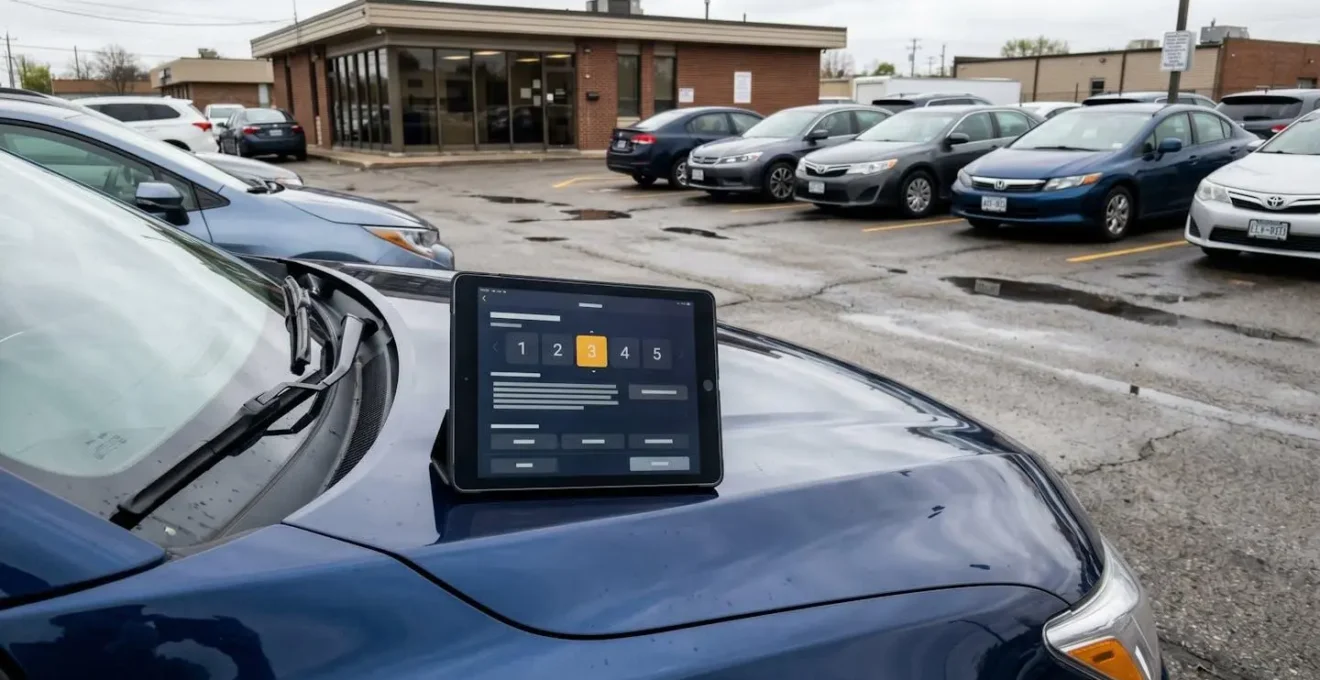
Standardised severity scoring eliminates this variability through objective measurement frameworks. Rather than allowing free-text damage descriptions, digital inspection platforms enforce structured assessment—typically a five-point scale where each rating corresponds to specific repair implications. A severity 1 rating might indicate cosmetic imperfection requiring no action, while severity 4 signifies structural damage necessitating immediate repair and customer rebilling.
The transformation from subjective to objective documentation fundamentally alters dispute dynamics. When a fleet presents evidence showing “door panel scratch rated severity 3 (repair required, estimated £180-220)” alongside timestamped photos and GPS coordinates, the customer can no longer attack the assessment as arbitrary staff opinion. The standardised scale provides defendable rebilling thresholds that withstand scrutiny.
Implementation requires more than simply adding rating buttons to inspection forms. Effective standardisation includes photographic reference guides showing example damage at each severity level, ensuring staff apply consistent criteria. A scratch measuring 8cm in length with paint penetration to primer layer always receives the same severity rating, regardless of which employee conducts the inspection or which rental location processes the vehicle.
Multi-location fleets gain particular advantage from standardised scales. Airport branches, city centre locations, and suburban sites all apply identical damage assessment criteria, eliminating the operational inconsistency that customers previously exploited by claiming different standards at pickup versus return locations. The standardisation also enables aggregate data analysis—fleet managers can identify recurring damage patterns and adjust pricing or vehicle selection accordingly.
The practical measurement methodology matters. Leading inspection systems combine the numerical severity rating with mandatory dimension capture (scratch length and width in centimetres, dent depth in millimetres) and standardised damage type classification (paint scratch, panel dent, glass chip, trim damage). This multi-layered objectivity creates documentation that dispute resolution bodies treat as credible evidence rather than dismissing as subjective staff opinion.
Real-time digital acknowledgment: closing the liability loop
What prevents customers from later claiming they were never shown damage documentation during check-in? Paper-based signature workflows create temporal disconnect—a customer might sign a condition report at the rental counter, but the actual damage photos are captured separately in the car park, with no cryptographic link proving the signature acknowledges those specific images. This evidentiary gap allows disputes where renters genuinely claim they never saw particular damage photos before signing.
Multi-party digital signatures resolve this vulnerability by capturing customer acknowledgment at the precise moment of photo review, creating an immutable link between the documented condition and the customer’s explicit acceptance. The workflow typically requires staff to complete the photo-based inspection, then present the tablet to the customer for interactive review—the customer scrolls through each damage photo, and their digital signature cryptographically binds to that exact image set with embedded timestamp and GPS metadata.
This closed-loop accountability eliminates the most common dispute scenario: “I never saw that damage during pickup.” The fleet can demonstrate not just that damage was photographed at a specific time and location (data points 1 and 2), assessed using objective criteria (data point 3), but that the customer personally reviewed and acknowledged those specific findings (data point 4). The four data types converge to create comprehensive evidence that arbitration bodies struggle to dismiss.
Fleet operators implementing the complete four-point data capture framework report significant improvements in successfully re-billed damage fees. Analysis of Hitech Software customer results (2025-2026) documents rebilling increases of 33%, demonstrating measurable financial recovery from previously unwinnable disputes.
The broader significance illustrates the importance of digital transformation for rental operators seeking competitive advantage through operational excellence. These four data points represent the minimum viable evidence standard for modern fleet management, where manual documentation no longer withstands customer scrutiny or arbitration requirements. Operators continuing with camera-based photos and paper signatures face escalating dispute losses as customer awareness of evidentiary standards increases.
Implementation priority varies by fleet type and operational model. Use this checklist to identify which data points deliver fastest ROI for your specific context:
- Photo timestamps with server-synced metadata (Priority 1 for high-dispute fleets managing short-term rentals)
- GPS-tagged inspection location coordinates (Priority 1 for insurance compliance, particularly peer-to-peer platforms)
- Standardized damage severity scale with 1-5 objective rating (Priority 2 for multi-location fleets requiring staff consistency)
- Multi-party digital signature cryptographically linked to photo set (Priority 1 for legal defensibility across all fleet types)
Rental disputes will continue as long as vehicles circulate between customers, but the evidentiary standard separating winning and losing disputes has permanently shifted. Fleets still operating with camera photos and subjective damage descriptions face compounding revenue leakage as arbitration bodies demand the four critical data types: verifiable timestamps, location proof, objective assessments, and customer acknowledgment. The question isn’t whether to implement comprehensive digital inspection—it’s how quickly operators can deploy these data capture capabilities before the next dispute erodes profitability that more prepared competitors are successfully protecting.