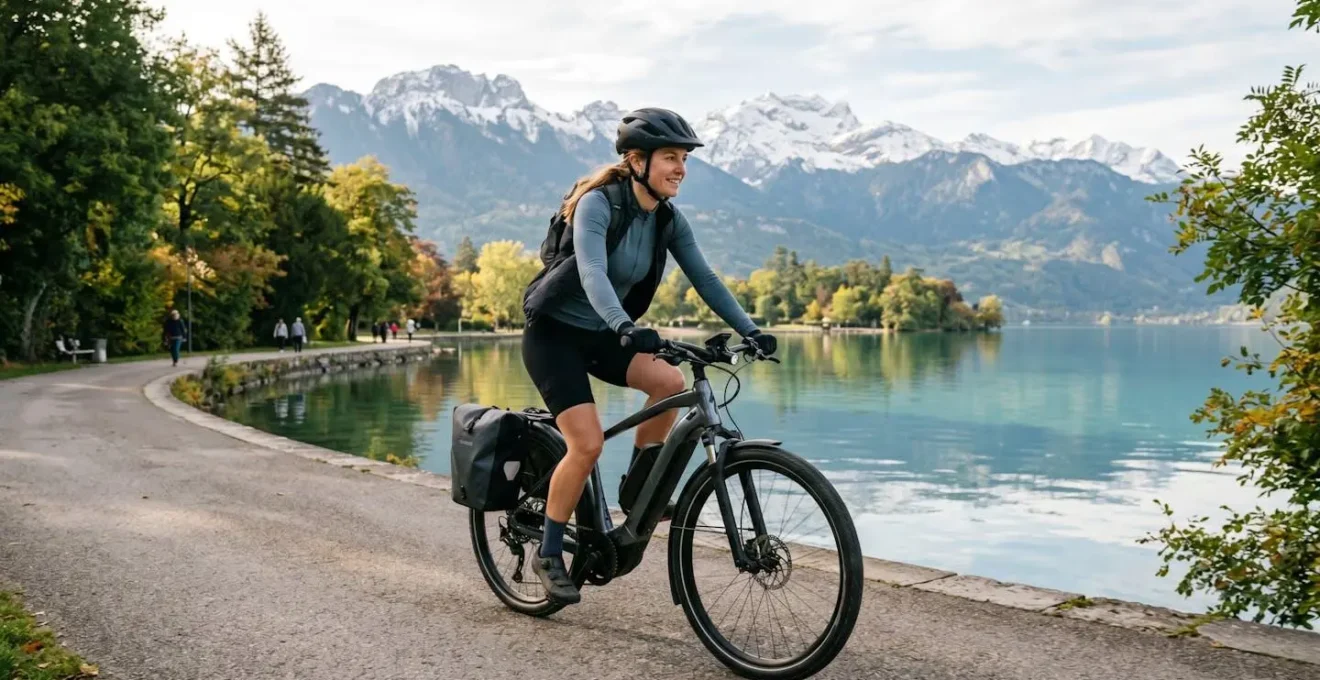
Tackling a steep Alpine climb on a traditional bicycle often transforms what should be a scenic outing into an exhausting ordeal. Electric bikes — VAE in French regulation — change that equation entirely. Pedal-assist technology redistributes the physical effort, letting cyclists cover terrain that would otherwise require significant athletic conditioning. Around Lake Annecy and throughout Haute-Savoie, this shift is already reshaping how visitors and locals choose to move through the landscape.
How pedal-assist technology actually works on mountain terrain
The principle behind a VAE is more mechanical than magical. A sensor — either measuring cadence or torque — detects pedalling input and triggers a motor to add proportional force to the drivetrain. According to the official definition published by the Ministère de la Transition écologique, the motor is capped at 0.25 kW continuous power and disengages automatically once the rider reaches 25 km/h. This regulatory ceiling is precisely what makes VAE feel natural rather than motorised: the rider still pedals, still steers, still engages with the gradient — the motor simply eliminates the peak muscular demand that most people find prohibitive on mountain routes.
On a standard climb, a cyclist without assistance must produce enough power to overcome both the forward resistance of the road and the gravitational pull of the incline. Slopes above 6% routinely push casual riders into their anaerobic threshold within minutes. With a VAE, the motor absorbs that gravitational load, keeping the rider comfortably within an aerobic effort zone. The result is not effortless cycling — it is sustained, comfortable cycling that can continue for hours without the penalty of accumulated fatigue.
One of the main reasons for the rapid growth of electric bike rental services around Lake Annecy is their ability to make challenging routes accessible to a much wider audience. Thanks to electric assistance, families, seniors, and visitors with different fitness levels can enjoy the same scenic rides that were once reserved for experienced cyclists. For those looking to explore the area, providers such as Mobilboard.com, offer convenient options to discover the region with ease.
VAE regulatory baseline: Under French law, a bicycle qualifies as a VAE when its continuous motor output does not exceed 0.25 kW and assistance ceases at 25 km/h — no licence, no specific insurance obligation.
The physical advantage on climbs: what the data shows
The energy savings linked to pedal assistance have been measured with enough consistency to draw reliable conclusions. A study by the ADEME — the French agency for ecological transition — found that VAE riders expend on average 30% less energy than conventional cyclists covering the same route. On flat urban commutes, this difference is noticeable. On mountain terrain, where energy expenditure per kilometre is substantially higher, the cumulative benefit becomes decisive.
30%
Average energy savings for a VAE rider compared to a conventional cyclist on the same route
The same ADEME analysis highlights a more striking metric: the average trip distance for VAE users reaches 9.7 km, compared to 4.8 km for riders on traditional bicycles. That is roughly double the range achieved without assistance. Translated to a mountain context — where detours around peaks, scenic lake loops, and village-to-village stretches regularly exceed 20 km — this difference determines whether a route is feasible or not for the average visitor.
A common scenario illustrates this point: a couple visiting Annecy for a long weekend wants to cycle the full perimeter of the lake. The route covers approximately 40 km with several climbs. On standard bicycles, completing this in a single day without prior training carries a genuine risk of exhaustion on the return leg. On VAE, the assist levels can be modulated throughout the day — higher assistance on climbs, minimal on descents — so the physical load stays manageable from start to finish. The pedal-assist system effectively acts as a variable gear that responds to the landscape rather than the rider having to anticipate every gradient.
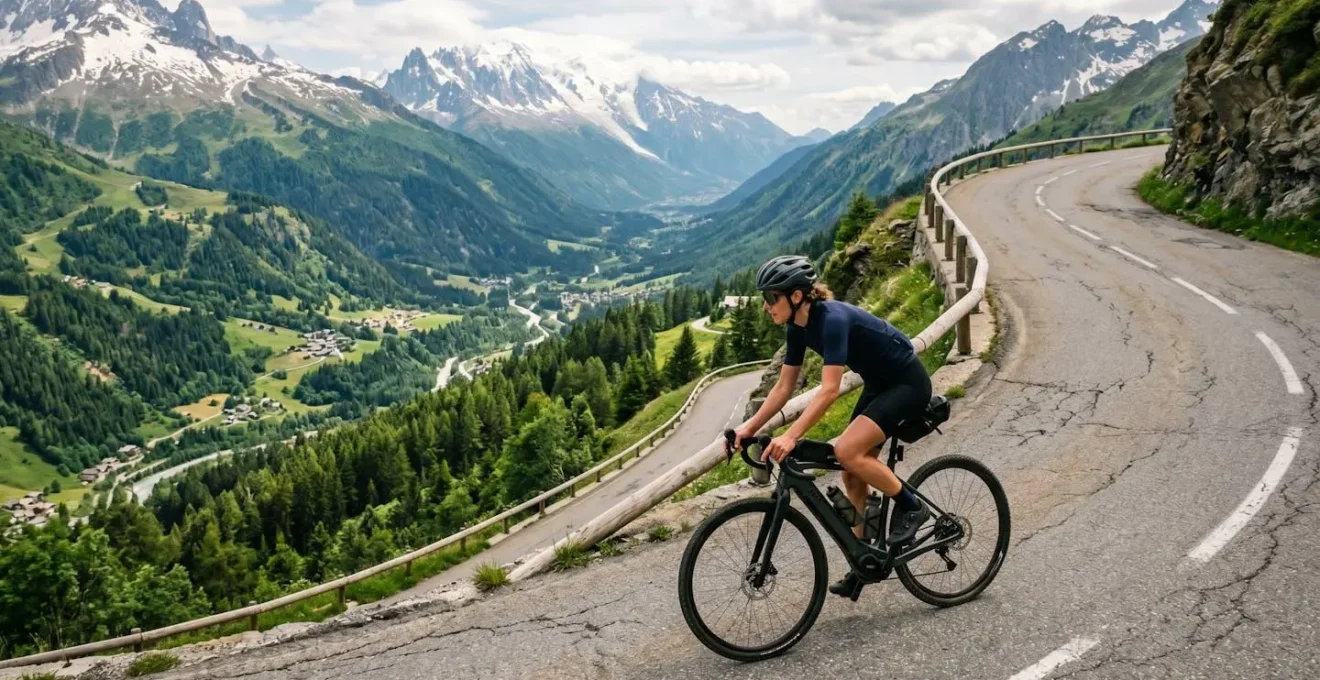
The environmental dimension reinforces the case further. According to the ADEME data, a VAE journey generates 97% fewer CO₂ emissions per kilometre compared to a car journey covering the same distance. For visitors to a protected natural environment like the Annecy basin — where sustainable practices are increasingly a collective priority — choosing soft mobility aligns the experience with the values of the destination itself. If the broader question of how industries adopt responsible frameworks interests you, the broader shift towards sustainable practices are reshaping modern industries provides useful context.
Battery range and long-distance capability
Range anxiety is the most frequently cited concern among people considering a VAE rental — the worry that the battery will run flat mid-route and leave them stranded on a hillside. The concern is understandable but, in practice, easier to manage than the anxiety suggests. Modern VAE batteries are rated according to the terrain, the assistance level selected, and the total weight of rider plus luggage. On typical Haute-Savoie routes combining flat lakeside paths and moderate Alpine climbs, a well-maintained rental battery provides ample range for a half-day or full-day itinerary when assistance levels are used sensibly.
The VAE battery management strategy matters more than raw capacity. Using maximum assistance throughout an entire 40 km mountain loop will deplete a battery faster than alternating between medium and low assistance on flatter sections. Most rental providers — including operations around Annecy — explain assist-level management during the handover briefing, which takes the guesswork out of the first outing.
Practical scenario: Group outing, full-day lake circuit
Consider a group of six colleagues organising a team-building day around Lake Annecy. Half the group cycles regularly; the other half has not ridden in years. On traditional bicycles, this mix creates an immediate gap — the experienced riders wait, the less fit members struggle on climbs, and the group dynamic suffers. On VAE, each rider independently selects an assist level suited to their current condition. The fit cyclists choose low assist and get a genuine workout; the less experienced riders select medium or high assist and keep pace without distress. The battery management advice received at rental pickup — prioritise lower assist on the flat, increase it selectively on the steeper sections near Talloires — lets every participant finish the circuit comfortably.
The data from the FUB supports the scale of this shift. According to the FUB’s annual cycling market report, VAE sales in France reached over 800,000 units in 2024, a 12.5% increase on the previous year, with VAE now representing 60% of total bicycle sales. This commercial trajectory reflects a straightforward reality: once riders experience the distance capability of a VAE on challenging terrain, the return to a conventional bicycle for comparable routes becomes genuinely difficult to contemplate.
60%
Share of VAE in total bicycle sales in France in 2024, up 12.5% year on year
The Annecy experience: routes, rental logistics and real-world feedback
Lake Annecy sits within a natural amphitheatre formed by the Aravis and Bauges massifs. The lakeside circuit is marked and largely flat, making it accessible to anyone who can ride a bicycle. The more rewarding routes — those that climb into the surrounding villages, reach viewpoints above the water, or connect Annecy to the Semnoz plateau — require either significant fitness or assistance. VAE rentals transform these routes from aspirational to achievable within the same afternoon.
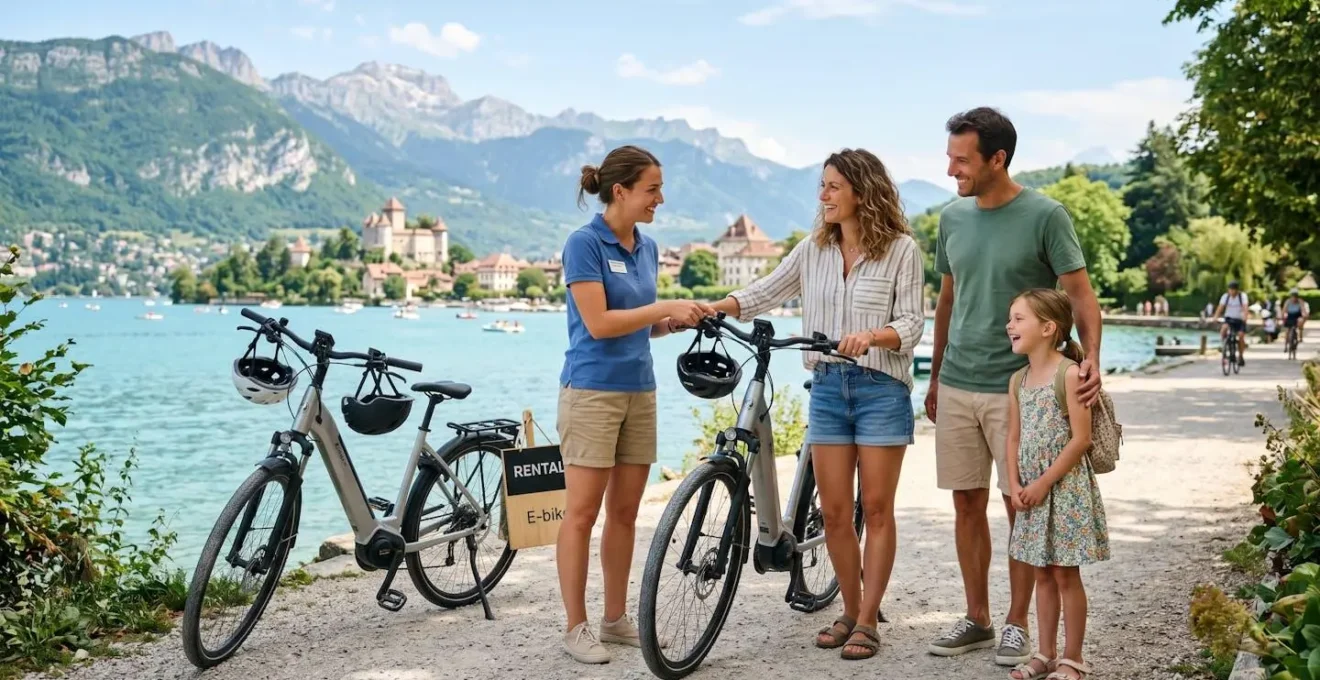
Rental formats around Annecy typically offer flexible durations — from a short urban exploration to a full weekend — so the commitment can match the available time exactly. Equipment included in standard rentals covers the essentials: a recent-generation VAE with charged battery, helmet, and lock. This removes the logistics barrier that often prevents visitors from cycling: there is no need to transport a personal bicycle, no uncertainty about compatibility with mountain terrain, and no concern about arriving at the end of a route without basic security equipment.
- Confirm battery charge level at pickup and ask the rental team about the expected range for your planned route
- Adjust saddle height before leaving the rental point — a few centimetres of misalignment creates discomfort over long distances
- Select a medium assist level for the first kilometre to calibrate how the motor responds to your pedalling cadence
- Identify at least one intermediate point on the route where you can stop, rest, and assess remaining battery if the circuit exceeds 25 km
Feedback from riders who complete VAE circuits around the lake consistently points to the same revelation: the routes that looked daunting on a map become straightforward in practice. The assist calibration — the ability to dial down effort on descents and increase it on the steepest sections near the cliff roads between Duingt and Doussard — turns what is technically a demanding Alpine circuit into an experience defined by scenery rather than suffering.
Do you need cycling experience to rent an electric bike in Annecy?
No specific experience is required. The VAE assist levels compensate for differences in physical condition or cycling frequency. Rental briefings cover the assist controls, so first-time VAE riders are operational within a few minutes of pickup.
Is the full lake circuit manageable on a single battery charge?
The full perimeter circuit of roughly 40 km is within the typical range of a modern rental VAE battery when assist levels are managed sensibly — using medium assistance on flat sections and higher assistance only on the steeper climbs. Rental teams advise on the specific battery and expected range at pickup.
Are VAE circuits around Annecy suitable for children and families?
The marked lakeside paths are flat and family-friendly. Electric bikes are available in formats that accommodate mixed groups — adults on VAE, younger children on adapted bikes or as passengers. The flexible rental duration means the outing can be scaled to the group’s pace.
The broader pattern visible across Haute-Savoie outdoor tourism is consistent: eco-responsible cycling with VAE has moved from a niche offering to a mainstream activity precisely because it solves the access problem without sacrificing the sense of genuine outdoor engagement. Riders still feel the mountain, still earn the viewpoint — they simply arrive there without having depleted every reserve they needed for the return journey. For those interested in how visibility and reach translate into activity bookings in the outdoor tourism sector, the mechanics of how SEO and SEA work together to boost business visibility online is a relevant read.
The next step before your ride
Annecy’s mountain backdrop does not have to stay a backdrop. With a charged VAE, the climbs that frame the lake become the route rather than the obstacle.